Olga's Gallery
June 07, 2003
These past days the Russian city of St. Petersburg has been celebrating its 300th anniversary. Three hundred years is a very short period in terms of history, but there is no doubt that the city deserves attention, most of all from the artistic point of view. The greatest European masters - architects, sculptors and painters - worked on its creation; in these terms the city is artistically part of world history.
We have decided to take a look into the early days of St. Petersburg:
its founding by Peter I the Great,
and its construction from the ground up, captured in the art of many artists,
both Russian and foreign.
St. Petersburg in Painting
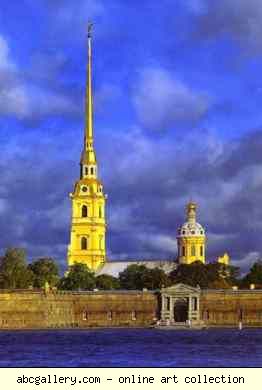 St.
Petersburg was founded in 1703, exactly three hundred years ago: a military
port to control the Baltic sea and protect Russia's trade with Europe against
the Swedes. Peter I personally selected the so-called Zayachy Island as
the location of what would later be known as the Petropavlovskaya (Peter
and Paul) Fortress. According to a witness, the tsar "took a bayonet from
a soldier, cut out two sods of turf and put one sod onto another in the
shape of a cross, then … made a cross out of a tree and, driving the cross
into the said sods of turf, he deigned to say: 'In the name of Jesus Christ
there shall be a church of the supreme apostles Peter and Paul in this
place.'" The SS. Peter and Paul Cathedral, a Russian Orthodox Church, is
now in the middle of the SS. Peter and Paul Fortress, the oldest part of
St. Petersburg.
St.
Petersburg was founded in 1703, exactly three hundred years ago: a military
port to control the Baltic sea and protect Russia's trade with Europe against
the Swedes. Peter I personally selected the so-called Zayachy Island as
the location of what would later be known as the Petropavlovskaya (Peter
and Paul) Fortress. According to a witness, the tsar "took a bayonet from
a soldier, cut out two sods of turf and put one sod onto another in the
shape of a cross, then … made a cross out of a tree and, driving the cross
into the said sods of turf, he deigned to say: 'In the name of Jesus Christ
there shall be a church of the supreme apostles Peter and Paul in this
place.'" The SS. Peter and Paul Cathedral, a Russian Orthodox Church, is
now in the middle of the SS. Peter and Paul Fortress, the oldest part of
St. Petersburg.
The architecture of the church is unusual for the Russian orthodox churches – it was designed by the Italian architect Domenico Trezini. The construction and decoration of the cathedral went on until 1733. Since then all Russian Emperors and Empresses, as well as members of their families, were buried there. The bell-tower of the Cathedral with its spire, crowned by an angel, dominates the fortress.
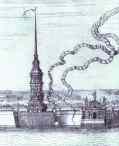 The
etching, dating 1716, and the modern photo show that the fortress remained
almost unchanged from the time, though in the middle of the 18th Centure
the wooden parts of the cathedral, including the bell-tower with the spire,
were ruined by fire, and were reconstructed according to the original plan.
The
etching, dating 1716, and the modern photo show that the fortress remained
almost unchanged from the time, though in the middle of the 18th Centure
the wooden parts of the cathedral, including the bell-tower with the spire,
were ruined by fire, and were reconstructed according to the original plan.
This etching with the view of SS. Peter and Paul fortress belongs to
one of the first Russian graphic artists, Alexey Zubov (1682-c.1750), pupil
of the Holland publisher and etcher Adrian Schoonebek (1661-1705), who
came to Russia on the personal invitation of Peter I and whose duties were
not only "creating visual documents" of the time (depiction of the buildings,
persons and events), but also teaching Russian apprentices. Among other
visual arts, etching attracted the tsar's special attention – practical
Peter I looked upon etching as a means of mass propaganda, and that is
why he always supported etchers. Zubov was among Peter's I favorite artists.
Alexey Zubov (1682- c.1750) became famous for his panoramic views of
the newborn capital, St. Petersburg.
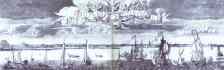
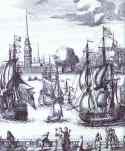 The
youthful energy, the impression of a new beginning that run through Peter's
I epoch, lives in the etchings of Zubov. Ships crowd the Neva River, cannons
fire, smoke flows from chimneys, ladies and gentlemen walk along the stone
embankments, carriages pass by – everything moves, everything lives. These
are not just views of the city. It's a dream, which realizes itself before
your eyes – many buildings and granite embankments, which are already in
Zubov's works, existed only as projects at the time.
The
youthful energy, the impression of a new beginning that run through Peter's
I epoch, lives in the etchings of Zubov. Ships crowd the Neva River, cannons
fire, smoke flows from chimneys, ladies and gentlemen walk along the stone
embankments, carriages pass by – everything moves, everything lives. These
are not just views of the city. It's a dream, which realizes itself before
your eyes – many buildings and granite embankments, which are already in
Zubov's works, existed only as projects at the time.
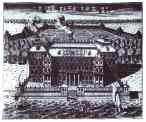 Among
the buildings Alexey Zubov painted from nature was the Menshikov palace.
Prince Alexander Menshikov, a close associate of Peter I, was appointed
the first governor-general of St. Petersburg. His residence, built between
1713 and 1727 under the architects D.M. Fontana, I.G. Shedel and D. Trezini
was really St. Petersburg's first palace (After Peter's death and Menshikov's
exile, the palace would become Russia's first military college, in 1731).
Among
the buildings Alexey Zubov painted from nature was the Menshikov palace.
Prince Alexander Menshikov, a close associate of Peter I, was appointed
the first governor-general of St. Petersburg. His residence, built between
1713 and 1727 under the architects D.M. Fontana, I.G. Shedel and D. Trezini
was really St. Petersburg's first palace (After Peter's death and Menshikov's
exile, the palace would become Russia's first military college, in 1731).
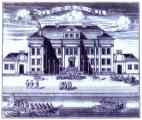
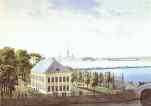 Peter
I himself contented with much more modest dwellings: the Summer Residence
and the Winter Palace, although he encouraged his subordinates to build
luxurious permanent residences for themselves in his new capital. The unpretentious
Summer Residence, designed by Trezini and built between the years 1710-1714,
was surrounded by the beautiful Summer Gardens.
Peter
I himself contented with much more modest dwellings: the Summer Residence
and the Winter Palace, although he encouraged his subordinates to build
luxurious permanent residences for themselves in his new capital. The unpretentious
Summer Residence, designed by Trezini and built between the years 1710-1714,
was surrounded by the beautiful Summer Gardens.
The Summer Gardens, the oldest park of St. Petersburg, were laid out in 1704. While on his trip to Europe Peter I was impressed by the royal parks of its monarchs. So the new garden was one of the first projects in the newborn city.
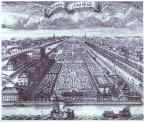
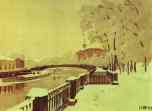 The
park had (and still has) strict geometrical planning. In Peter's time all
trees and bushes were trimmed in the most elaborate way in accordance with
the fashion. The marble statues of famous Italian masters were bought for
the alleys and covered galleries. Peter I used to organize receptions and
balls there, which were called assemblies. The most popular entertainments
of the day were fireworks, dancing, drinking and theatrical shows.
The
park had (and still has) strict geometrical planning. In Peter's time all
trees and bushes were trimmed in the most elaborate way in accordance with
the fashion. The marble statues of famous Italian masters were bought for
the alleys and covered galleries. Peter I used to organize receptions and
balls there, which were called assemblies. The most popular entertainments
of the day were fireworks, dancing, drinking and theatrical shows.
Among the oldest foundations of St. Petersburg is the Admiralty. The original Admiralty was designed as a shipyard, and was founded by Peter I himself in 1704. The first ships of Russia's Baltic fleet were built there, some of them with the personal participation of Peter I, who was an expert shipbuilder.
In the 1730s the architect I.K. Korobov erected stone buildings and the spired tower. The Admiralty at the time was a fortress and was surrounded by ramparts and canals.
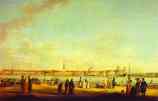
 The
View of the Admiralty As Seen from the Embankment of Vasilyevsky Island,
c. 1796-1803, by a German painter, Johann Georg Mayr (1760-1816), gives
an idea of how the place looked at the beginning of the 19th century. Only
three years later, the general reconstruction of the complex began. The
Admiralty that we can see today was built in 1806-23 by Adrian Zakharov.
The
View of the Admiralty As Seen from the Embankment of Vasilyevsky Island,
c. 1796-1803, by a German painter, Johann Georg Mayr (1760-1816), gives
an idea of how the place looked at the beginning of the 19th century. Only
three years later, the general reconstruction of the complex began. The
Admiralty that we can see today was built in 1806-23 by Adrian Zakharov.
He maintained the original plan of the building, but turned it into a marvelous example of the Russian Empirical style, with rows of white columns, plentiful reliefs and statues. The gilded spire of the Admiralty is topped by a weather-vane in the form of a little ship. The Admiralty used to be the naval headquarters of Russia till 1917, and now serves as a naval college.
In 1712 (?) Peter transferred the capital of his Empire from Moscow to young St. Petersburg. After his death in 1725 his successors continued to develop the capital in accordance with the general plans and the high artistic tastes of the time, but development slowed. It got a new push from Catherine II and particularly Alexander I who sought to turn their capital into one of Europe’s greatest cities and cultural centers. The city always had a general plan of development and new buildings were constructed as parts of already existing ensembles.
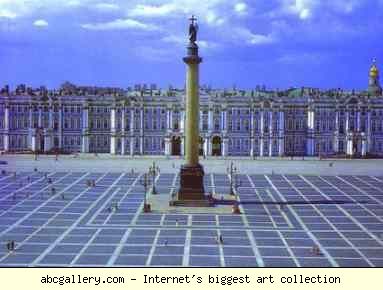
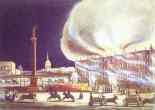 The
Baroque Winter Palace was built in 1754-62, by the favourite architect
of Empress Elisabeth, Bartolomeo
Franchesco Rastrelli (1700-1771). By the time it was finished Elisabeth
had already died. Her successors, starting with Catherine
the Great, made the palace their main official residence. Many of the
impressive interiors have been remodeled since then, particularly after
1837, when a huge fire destroyed most of the palace.
The
Baroque Winter Palace was built in 1754-62, by the favourite architect
of Empress Elisabeth, Bartolomeo
Franchesco Rastrelli (1700-1771). By the time it was finished Elisabeth
had already died. Her successors, starting with Catherine
the Great, made the palace their main official residence. Many of the
impressive interiors have been remodeled since then, particularly after
1837, when a huge fire destroyed most of the palace.
Nowadays the Winter Palace, together with four more buildings, houses the collections of the State Hermitage Museum, which is the largest art collection in Russia and is among the largest and most respected art museums in the world. The Museum was founded in 1764 when Catherine the Great purchased a collection of 255 paintings from Berlin. Now the museum has about 2.7 million exhibits.
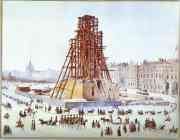 The
Winter Palace is fronted by the vast Palace Square, featuring the Alexander
Column, a monument to victory over Napoleonic France. The Alexander Column,
erected in 1830-34 by the architect Auguste de Montferrand (1786-1858)
and sculptor Boris Orlovsky (1792-1837), creates an important focal point
for this great architectural ensemble. The column, devoted to the military
victory over Napoleonic France, was named after Emperor Alexander I, who
ruled Russia in 1801-25.
The
Winter Palace is fronted by the vast Palace Square, featuring the Alexander
Column, a monument to victory over Napoleonic France. The Alexander Column,
erected in 1830-34 by the architect Auguste de Montferrand (1786-1858)
and sculptor Boris Orlovsky (1792-1837), creates an important focal point
for this great architectural ensemble. The column, devoted to the military
victory over Napoleonic France, was named after Emperor Alexander I, who
ruled Russia in 1801-25.
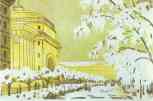
The southern side of the square is encircled by a classical yellow-and-white building, built in 1819-29 by Carlo Rossi. This building used to house the Headquarters of Russia's Imperial Army. In its central part the building has an arch, designed as a Triumphal Arch.
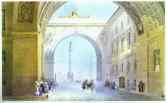 Via
the Arch, the square comes out onto the Nevsky Prospect – the city's main
avenue. This latter was originally the road that connected the St. Petersburg
with Novgorod, but as buildings began to grow around it, it turned into
a part of the city. The avenue holds many churches of different denominations,
which prompted the French writer Alexander Dumas to call Nevsky "the street
of religious tolerance".
Via
the Arch, the square comes out onto the Nevsky Prospect – the city's main
avenue. This latter was originally the road that connected the St. Petersburg
with Novgorod, but as buildings began to grow around it, it turned into
a part of the city. The avenue holds many churches of different denominations,
which prompted the French writer Alexander Dumas to call Nevsky "the street
of religious tolerance".
We have to restrict our story to just a few places of St. Petersburg. On the web site you will find more stories about its places of interest and about some painters who depicted it, among the others, the Italian architect and graphic artist Giacomo Quarenghi (1744-1817), Swede Benjamin Paterssen (1750-1815), Germans Johann Georg Mayr (1760-1816) and Wilhelm Barth (1779-1852), Russians Andrey Martynov (1768-1826), Vasiliy Sadovnikov (1800-1879), Prince Grigory Gagarin (1810-1893), Anna Ostroumova (1871-1955).
In 1914 with the outbreak of the First World War the city changed its name into the Russian-style name of Petrograd (grad is old Russian for gorod – city, lit. Petercity).
Following the Russian Revolution in 1917 and the transfer of the capital to Moscow in 1918, Petrograd lost its status in the eyes of the new governors of Russia, or the USSR. Nevertheless, Petrograd—renamed Leningrad following Lenin’s death in 1924—sought to maintain its identity. Stalin especially disliked the city for its individual spirit.
During the Second World War Leningrad heroically withstood an 872-day German siege, during which many hundreds of thousands died of famine and disease and the city’s historic core sustained enormous damage from bombardment.
After the collapse of the Soviet Union in 1991, Leningrad's residents voted to restore the city's historical name of St. Petersburg.
We congratulate the residents of St. Petersburg with the anniversary of their city and invite you to have a virtual walk through the city with the help of different artists and our notes.
Recommended reading:
St.
Petersburg: A Cultural History by Solomon Volkov, Antonina
W. Bouis (Translator). Free Press, 1995.
St.
Petersburg: Architecture of the Tsars by Dmitri Shvidkovsky,
Alexander Orloff (Photographer), John Goodman (Translator). Abbeville Press,
Inc., 1996.

